
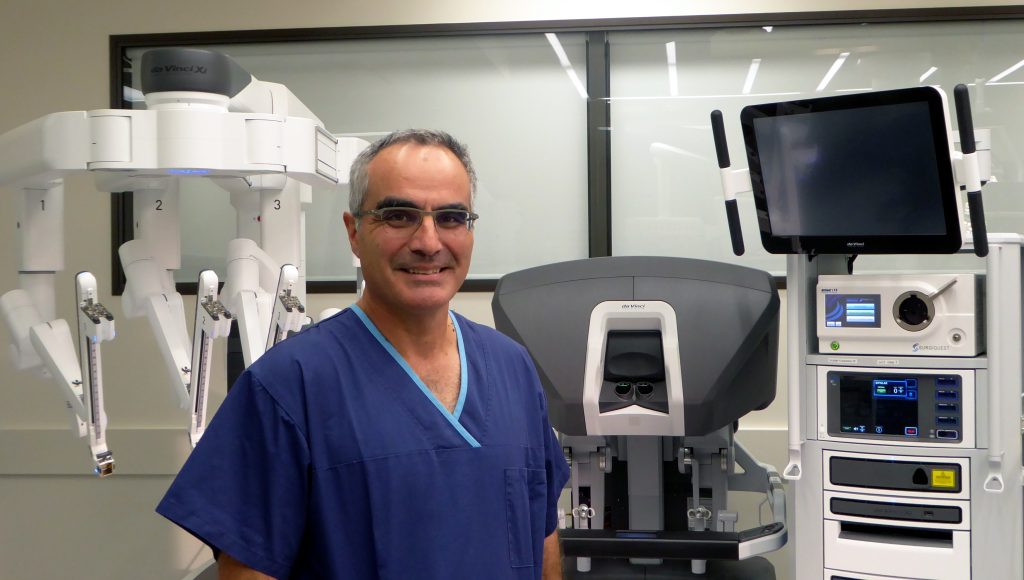
Jonathan Koea, professor of surgery, University of Auckland. (Photo supplied)
When Jonathan Koea did his general surgical training in the 1990s, there was only one other Māori surgeon in the country (Peter Tapsell, who’d trained as an orthopaedic surgeon and was a Labour MP by then). But, all these years later, there are still only 20 Māori surgeons in the country, out of a total of 800. Jonathan is helping to change that — and, as he tells Dale in this kōrero, it’s one of the highlights of his work as a professor of surgery at the University of Auckland.
Tēnā koe, Jonathan. I’ve long been aware of your mahi, and it’s a pleasure to have a kōrero with you. How long have you been doing what you’ve been doing?
Oh, Lord. It doesn’t bear thinking about. I came back from the States in 2001. So, yeah, I don’t know. Where does the time go?
I hope that life has been good to you, because I know you’ve done your best by a lot of people over the years.
I’ve been incredibly lucky to have an interesting and challenging life, which is the sort of life that you want, I think.
Do you have a family, Jonathan?
Yeah. My wife Lisajane and I met in New Plymouth just after school, and we have four kids: India, Wiremu, Liberty and Honor. Empty nesters now, though. We all seem to get on and enjoy spending time together, so that’s good. It doesn’t always happen that way for surgeons. I’m lucky to be part of a great family, but that’s probably more a reflection on my wife’s ability as a parent than on mine.
My wife and I are empty nesters as well, but the mokopuna and the tamariki are constantly coming back for a feed!
I think we’ll be going down that route pretty soon. To be honest, I love it when the kids come back. But they’ve also got to go away and do their thing, you know? That’s how you make your way in the world.
Are any of them following in your footsteps?
No. None of them did. They’ve all gone the creative route. We’ve got a pastry chef who works in Auckland. I can’t say where, because that’d be advertising! One daughter has just about finished studying animation down in Wellington, and another one is doing philosophy and classics at Victoria. And our oldest lives with her partner in Miramar where he works for Weta Digital.
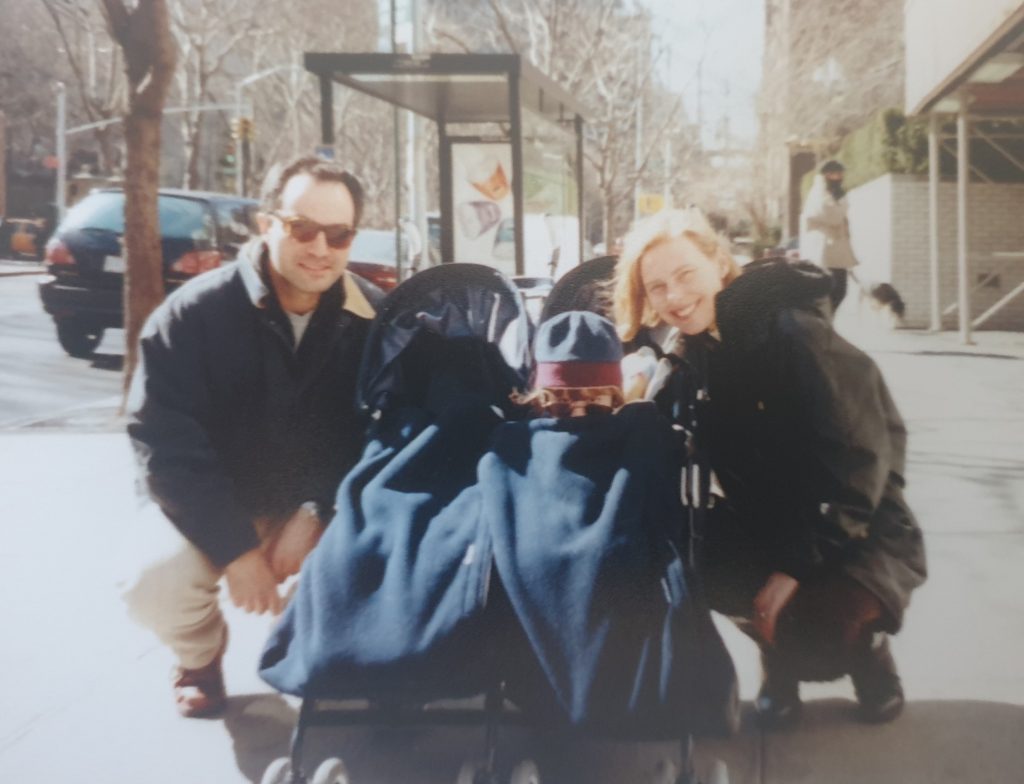
Jonathan and Lisajane in New York during his surgical fellowship at the Memorial Sloan-Kettering Cancer Centre. With son Wiremu, sound asleep on the left of the stroller, and daughter India on the right. (Supplied)
You’ve got creative hands, too, Doc, so perhaps they’re following in your footsteps in ways that will unfold in the years ahead. But I’m getting ahead of myself. Could you tell us a little about your parents and where you grew up?
I’m an only child. My family tell me that I fit the only-child stereotype very well. I was born before there were anti-Rhesus treatments available. So, if you had more than one child, there was a greater chance that the subsequent children would be anaemic and require in-utero transfusion. So, Mum and Dad only had me.
My dad was George Koea. He was a journalist. He was the first Māori newspaper editor in New Zealand. He died in early 1987. But he’s still well known amongst journalists, and people talk very kindly of him. I suspect he was probably quite a tough boss, but he was also very kind. He helped many people along the way and that’s what people remember.
His whānau all did well. His sister, the middle child, was Marama — Marama Martin or Marama Koea. And broadcasters of a certain age, and patients of a certain age, remember her as reading the news and the weather, and also being on Beauty and the Beast, which was a TV panel show that ran in the middle of the day. She had an amazing voice and presence. She’d trained as a teacher initially, and when she finished in broadcasting, she went back to teaching and ended up being the head of The Correspondence School for a long period of time. Teaching was her first love, I think.
Dad’s younger sister was Moana Sharland, and she’s still alive in her 90s. She was New Zealand’s first Māori physiotherapist. So they were quite a well-achieved group of kids really, when you think that both their parents were Māori.
George and Isobel Koea, my grandparents, grew up in New Plymouth in the 1920s and ‘30s. Both of them were reo speakers, but they didn’t pass it on to their children. I think that was a conscious decision, and common for the time. It was based on a perception of the greatest chance of survival and progress. They would have beaten at school at school for speaking the reo.
It wouldn’t have been that easy for them, but all their children did well and raised families. I’m proud to whakapapa to them.

Grandparents Isobel and Teoti Te Koea (George Koea). With Jonathan’s aunt Marama, on Isobel’s knee, and dad George Koea.
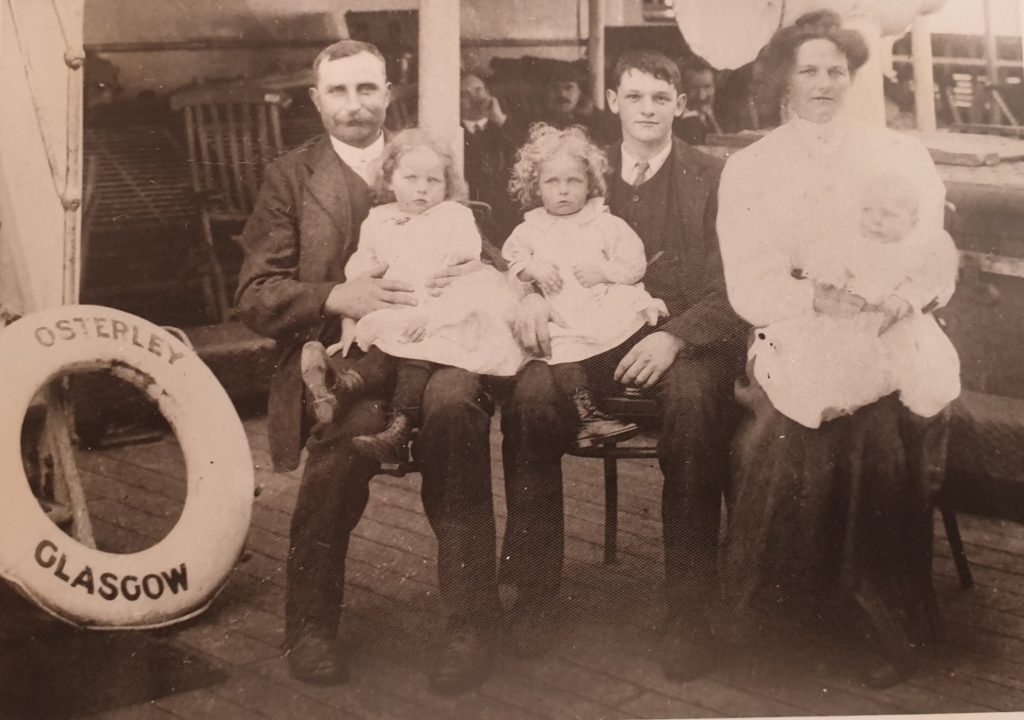
Jonathan’s maternal grandmother Margery Jennings on her father’s knee (right) on the Osterley emigrating from Ireland to New Zealand. (Supplied)
My mum’s side are Irish. Tough Irish immigrants who came out in the early 1900s and started as farm workers, and then gradually saved up and bought farms. My middle name is Barnes, because that’s my mother’s maiden name. My mother is Shonagh Koea, and she’s a short story writer and novelist.
In the last few years, I’ve gone back to Te Wānanga o Aotearoa and started learning te reo again. I had some knowledge, but not great, and it’s been a beautiful thing to go back into my whakapapa and my rohe and really get to understand the place names and the people and where I come from. It’s felt like a necessary part of my education and grounding process.
One of the lovely things for me in the last year is that I found a picture of my great-grandfather Te Koea McClutchie. That’s where the name Koea comes from. Te Koea died at Parihaka in about 1905, from tuberculosis, leaving my grandfather George Koea orphaned at the age of five. He was brought up by my great-uncle, Te Kapinga McClutchie, who was the tuakana and a prominent leader of our iwi.
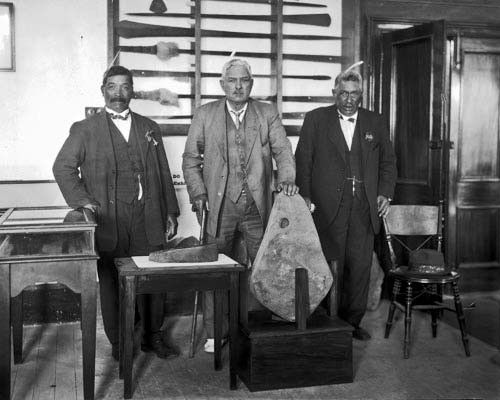
Jonathan’s great-uncle Te Kapinga McClutchie (middle) presenting Te Punga a Matori, the anchor stone of the Tokomaru waka, and Putama Whiria, the adze used to carve Tokomaru, to the Taranaki museum. On the left of the photo is Nohomairangi Te Whiti (Taranaki, Parihaka) and on the right, Rangi Matatoru Watson (Te Atiawa, Waitara).
Actually, my grandfather’s name wasn’t George. It was Teoti Te Koea — Teoti being Māori for George. But a few things got dropped and changed around and sons often took their father’s first name as a surname. It was quite an emotional moment to find an image of my great-grandfather, and then of his father as well. He was Tamati Makaraiti, or Thomas McClutchie, who brought Ngāti Mutunga and Ngāti Tama people back from the Chatham Islands. He also had a distinguished career, and really got Ngāti Tama re-established back in Taranaki in the late 1800s, after their displacement.
Did I hear you right? That your parents had only you because of a rogue gene or something?
It’s all to do with blood groups. Let me try and get this right in my head. If a mother has a negative blood group, such as A-, but the foetus has an A+ blood type, that positive protein can cause antibodies from the mother to attack the baby’s blood, and the foetus can become anaemic in-utero and develop heart failure.
And it was a huge problem, particularly for Māori, because most Māori have A+ blood group. It’s very common throughout Polynesia. In the late 1960s, early ‘70s, Sir William Liley, who was a New Zealand researcher at the University of Auckland, developed a vaccination against that positive factor. An amazing contribution when you think of the number of lives saved or made possible.
So now, when mums have babies, they often get what’s called anti-D immediately after birth, because that stops the mother developing antibodies to the positive factor. In the ‘60s, when I was born, that didn’t exist. There was a real risk that, once you had one child, if the second child had a positive blood group, then it could become anaemic, develop heart failure, and die. It was a very common problem for a long time. Not so much now.
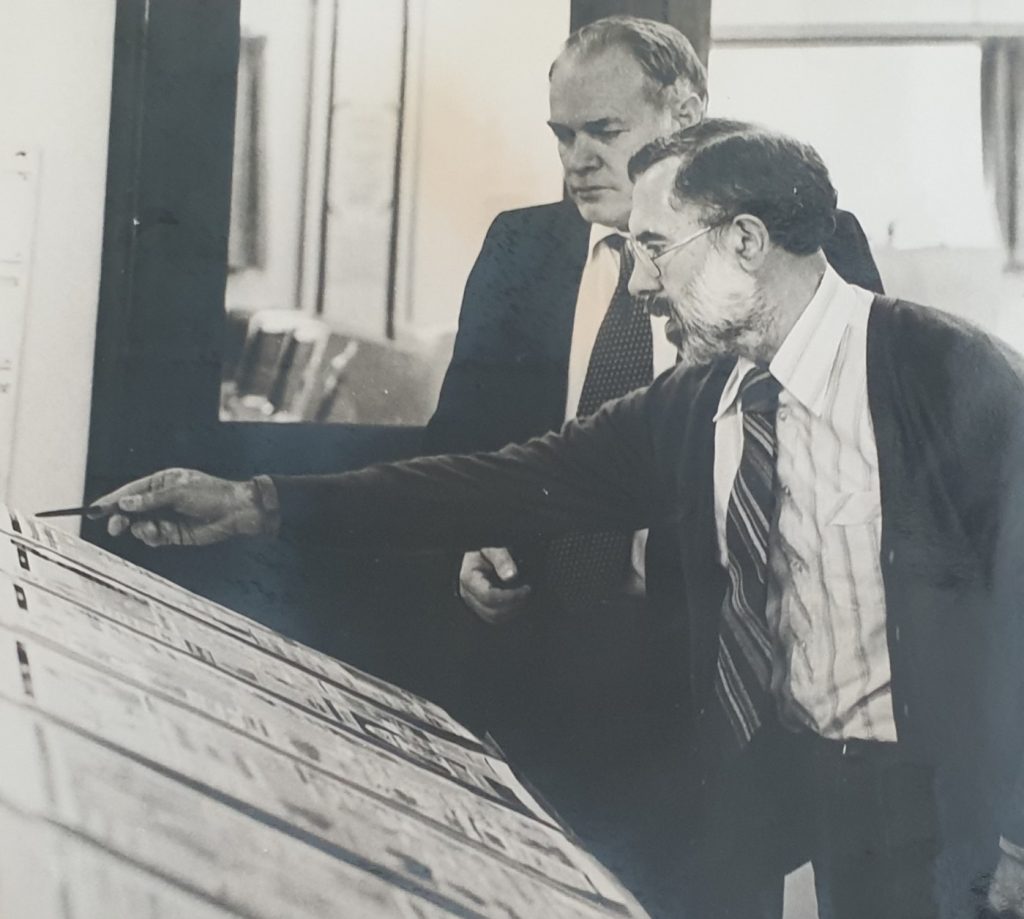
George Koea, Jonathan’s father, was the first Māori editor in the country. He’s pictured making up the pages of the Taranaki Herald. (Supplied)
Part of the reason I asked to go back to that, Jonathan, was I was wondering where your interest in medicine developed from, and whether there was something about your own history that encouraged you along that learning path. Tell us about that journey. Was there a mentor in your high school years who said: “Hey, young man, medicine might be for you.”
Yeah, I had a couple of science teachers who really helped — Dr John Riddle and Mrs Barbara MacDonald. I always liked science, but also English and creative writing. But I ended up thinking about medicine when I was in the seventh form, which is Year 13 now, basically because I liked sport. I was hopeless at it, but I really liked the idea of training with a goal in mind and optimising physical performance — and also the psychology of how you build good teams. Now, I suspect I’d end up being a coach or on a coaching panel, though it’s a very insecure way to make a living, coaching. You’ve either been fired or are about to be fired.
I went for medicine because, at that time, I liked the idea of sports medicine. As I said, I had a couple of science teachers who really believed in me, and they sent extra work my way. I went to a small school, and, to get into medicine, you were competing against kids from big Auckland schools and big Wellington schools who were coached on how to sit exams. That was quite hard to do in a smaller school, where I think my seventh form had seven students.
What high school are we talking about?
Francis Douglas Memorial College in New Plymouth. It’s famous now because all the Barrett boys — Beauden and Jordie and Scott — went through there, along with their dad. We had no All Blacks when I was there, but they’ve had quite a crop since then. Conrad Smith is another one from there. And, academically, it was always a good school.
So, yes, I had people pushing me towards medical school. I think I was the last one in the door. I was probably the lowest A-bursary they’d ever had. I got in on the MAPAS programme, which was the Māori and Pacific Admission Scheme. Which was really good, because, certainly then, if you didn’t go through MAPAS, the selection was really only on exam marks — and that’s not a great predictor of how things are going to turn out. As MAPAS students back then, we were interviewed and had to have whānau and community support, and we had to demonstrate some commitment to community work.
Now, the admission process for everyone is a lot more detailed, and in some ways, is based on that MAPAS approach. Admission considers community service and engagement, health activities, marae activities, working with kaumātua — all sorts of things. Which gives you a much better idea of the type of person and how they’re likely to conduct themselves when they’ve finished training.
It’s a very political topic, isn’t it? When you look back at how it helped shape your career, do you think it’s imperative that something like that is maintained?
There’s definitely an acknowledgment that the medical profession in any given place should reflect the community that it’s serving, and that you need individuals with many different skill sets and knowledge bases. For me, coming from a small school, MAPAS was my chance. It levelled the playing field a little. We were taught well, but we just didn’t have the academic oomph that kids from larger, more exam-focused schools had.
Dr Shane Reti was in my intake year, in 1982. He came in on the MAPAS programme as well. You got a little bit of help once you were in, but not a huge amount. It was sink or swim, but most people swam. My year had the biggest number of Māori and Polynesian admissions up to that point. We had seven or eight come in, of whom seven graduated. One girl left quite early on because she was very good at mathematics, and she went on to become a professor of mathematics in the United States, I think.
When you look at the MAPAS programme, those students generally come in with real drive, resilience, great life experience, and a skill set that’s perhaps different from many of their classmates because they’ve often had to make their own way in the world. MAPAS students have usually developed the skills to conduct themselves in multiple worlds, while also being able to relate to specific populations.
It’s interesting. Otago — particularly under Jo Baxter, who’s the first Māori dean of the Dunedin School of Medicine and was also in the 1982 MAPAS intake — now has a rural pathway. So, if you’ve grown up in a rural area and you’ve gone to a rural school, they recognise that unique life experience and skill set as a qualification for medical school entry.
You know, academic prowess is one thing, but there’s a whole lot of things that we look for in our doctors and our medical people, and getting the mix right and choosing right is hard and complicated.

Jonathan graduating in 1996. From left: Parents-in-law Kerry and Marilyn Williams, aunt Donnie Ngamoki from Omaio, Jonathan, his wife Lisajane, and mother Shonagh Koea. (Supplied)
I was wondering about what makes a good surgeon, and I wonder if we might talk about relationships with your patients, and the way you communicate with them. Many of them face life-threatening situations. How important is communication prior to and after major surgeries?
That’s a great question. Some degree of technical dexterity is important, of course, but that can be taught to a degree. And you need resilience and the ability to keep a clear head and retain facts.
It’s a cliché, I suppose, but the world is so interconnected now that communication and emotional intelligence is probably the number one skill in almost any job. I’m lucky because I’ve always really liked talking to patients, partly because I’m curious but also because virtually every patient I meet is a great person — and you always learn something interesting talking to patients.
I know that sounds kind of lame, but most people are fantastic, and I always find out something that I didn’t know. I always ask people where they live or what they do, or are they related to this person and that person. I think that’s quite a Māori way of doing things, because we have this map of the world in our heads, and we’re very into whakapapa and where people come from, and how they fit into the great map of the world in space and time.
I try to be really honest with people. The straightforward communications are straightforward. Most people want to know when the situation is tricky too. I think you just have to lay it all on the line. Particularly with the really difficult conversations. You can’t dress them up as being anything other than a really difficult conversation. Patients are smart and clever, and if they’re given accurate information and the time to make a decision, they know what the best course of action is.
When things are bad, I try to always give people a plan. If you just dump bad news on people, that’s a lot to process. I know that if I was in that situation, I’d want a plan — even if the plan is just to stay as well as you can for as long as you can.
A lot of my work is with cancer patients — and, for people with late-stage metastatic cancer, it’s really important for them to know that they will always be able to access care, and that there’ll always be somebody there for them. If people know that, then they’re less likely to want to stay in hospital. They’re more likely to go home because they feel more secure that there’s a safety net if they need it.
A lot of your work is unseen. So there’s a lot of trust needed. Take us into the work that you do.
The process, if you want to call it that, often starts a long time before the surgery. Most of my work is about cancer, so the questions are: Where’s the cancer, how fast is it spreading, what is it affecting, and is an operation even technically possible? And sometimes those deliberations take place over several weeks and require multiple investigations.
Sometimes, the conversation is along the lines of: “I think that we can do this, but we won’t actually know till we get there”, as opposed to: “Yup, this is routine, we’ve done many of these, we expect this will go fine.” The conversations where the outcome is in doubt are tough to have with patients, and I’m always amazed at how well most people handle that sort of unknown, that uncertainty factor. But, as I said, patients almost always make the right decisions for themselves.
I often say that the outpatient clinic is the most stressful part of the job, because you’re never quite sure what sort of space people are in, or what they’ve heard or read and what they bring to the consultation.
The operating theatre itself is quite a controlled space. There’s a bunch of people there who are generally there every week, and it really becomes a question of, can you execute a specific operation or series of manoeuvres to accomplish what you need to do? Then it’s really getting people through the post-op period, avoiding complications, and making sure people stay motivated and get up and walk every day.
It’s often quite a prolonged process. Certainly, for major surgery, it’s three to six months before patients feel completely normal again, and I think part of that is because there’s a mental process of getting through the surgery, getting through the recovery and the rehabilitation, and then going: Yep, done, that’s finished. Put a line under that and move on to the next part of life.
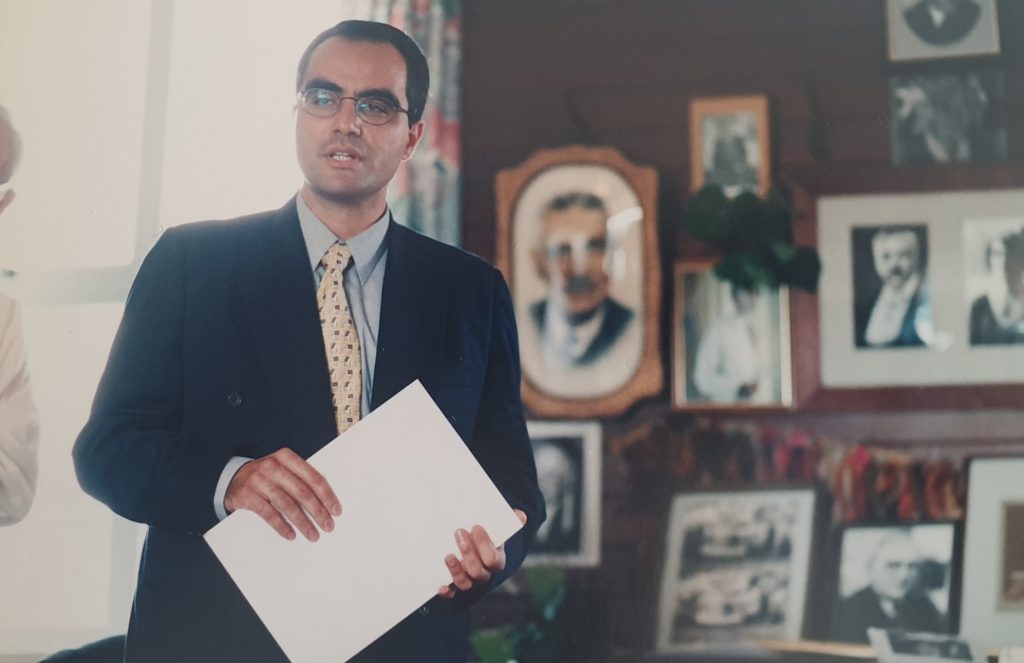
Jonathan, speaking at Urenui Pā in Taranaki, after receiving the Eru Pomare Research Scholarship in 1997.
You’re a surgeon, but you’re also a professor of surgery. If somebody asks you who you are and what you do, what do you tell them?
“Somebody who can’t say no!”
Look, surgically, I’m classified as a hepatobiliary surgeon, which is liver and pancreas, and a general surgeon, which is abdominal. I’m also fortunate enough to have a university position. They made me a professor a couple of years ago, and that gives me an opportunity to contribute to the great work being done at the University of Auckland. I do research work and get to teach.
I love the surgery, and I love the patients. But the teaching and the research is just as engaging now. I certainly enjoy interacting with medical students and young doctors, because they’re different from what we were like when we came through. Better, in many ways, I think. I don’t worry about the future of medicine in this country. I think the future will be different from what my generation might anticipate, but I think the young people coming through are pretty amazing. They’re deep thinkers and accomplished problem solvers.
You put together a lecture recently about the Māori versus western worlds in surgery, and the need for balance. I’m intrigued about what you see as the potential for utilising dual knowledge systems.
As you know, a lot of people in our grandparents’ generation would speak Māori at home, but they made a deliberate decision not to teach their children te reo. They knew that their kids had to do well in school to survive. It was a survival decision, and we’ve survived so they weren’t wrong. But we did almost leave some taonga behind.
So, Dad grew up without te reo, and I didn’t really have it either. When I was at high school, there was literally nobody in New Plymouth who would teach te reo. I think there just weren’t that many speakers. Of course, since then we’ve had the kōhanga generation and the kura generation and it’s all coming back.
For me, one of the big things is to try to fill the gap that’s there through not having that grounding in te reo. I felt bad about that for many years but my class at the wānanga is full of Māori with similar stories. It’s just the way it was and is. But now there are so many channels to learn again and fill that gap.
A lot of people think you’re either Māori or non-Māori, but I think, in the future, we’ll see that we’re all elements of everything. My mum’s side is Irish, and I’m very proud of them. I don’t like it when they beat us at rugby, but if we must lose to a team, I’m happy to lose to the Irish. We’re an amalgam of everything that makes us up and that gives us strengths to be able to understand different knowledge systems, and different points of view and worldviews. I’ve always felt that I’ve had to walk in two worlds, and had to try to make those worlds one.
Life’s not all about work. What do you do that keeps you ticking on and enjoying life?
I always feel bad when I’m asked that because I think I should have an amazing hobby like collecting Peruvian stamps from the 1700s or something like that. I’ve always done some physical exercise every day. I think it’s good, and the older I get, the more I think it’s actually for your mind rather than your body.
Also, I quite like renovating houses. When I think about it, that’s just another form of surgery. It’s problem-definition and problem-solving.
But the thing I’m really enjoying now is the work of trying to increase the numbers of Māori surgeons. There are 20 of us now out of about 800 in the country. But as of early next year, we’ll have 38 young Māori training in surgery. So that will give us 58 in total.
That’s been a process of going around to schools and talking to Māori secondary school students. It’s been a lovely thing. These kids are amazing. Most of them are from the kōhanga generation and they’ve been through kura, so they’re bilingual. Some of them are multilingual. They’re very comfortable with tikanga and the kawa of both Māori and Pākehā worlds. Many of them have been representative sports people, they’re academically really smart, and super grounded with their families.
As for the obstacles that I and my generation saw when we came through, they don’t see them at all. They just decide where they want their waka to go and start paddling. I think we’ll be okay.
(This interview has been edited for length and clarity.)
Thank you for reading E-Tangata. If you like our focus on Māori and Pasifika stories, interviews, and commentary, we need your help. Our content takes skill, long hours and hard work. But we're a small team and not-for-profit, so we need the support of our readers to keep going.
If you support our kaupapa and want to see us continue, please consider making a one-off donation or contributing $5 or $10 a month.


