

Communities in Pātea “continue to insist that we protect papa moana, the seabed,” writes Kate Paris, pictured here with sea-lion pups on the Auckland Islands in 2013. (Photo supplied)
They’re holding the line in Pātea as the sand-miners roll closer, writes Kate Paris.
Money-hungry nature-wreckers coming to Aotearoa to extract resources are nothing new. It’s a story as old as the forest-stripped hills. Much of the debate surrounding Trans-Tasman Resources’ plans to mine the seabed off the coast near my home in Pātea has played out like a tug-of-war between the would-be miners and kaitiaki iwi — and I’ve been watching.
I’ve seen brash ministers and company men on one side, talking up the financial gains for the people who live here, despite murky forecasts from a dodgy developer drowning in debt. Back in May, the coast off South Taranaki was described in parliament as “a bog standard seabed that represents a chance for the region to generate jobs and make money”.
On the other side sit mana whenua and iwi, councils, scientists, community and environmental groups. They have spent years learning exactly what is at stake, fighting for it all the way to the Supreme Court. And they continue to insist that we protect papa moana, the seabed, from the inevitable harm that sucking up 50 million tonnes of the seabed — and dumping 45 million tonnes back into the moana — will do.
They don’t want, or need, to turn Mothering Bay into a sediment-filled soup. Kororā have been documented swimming a hundred kilometres from the Marlborough Sounds to feed at the Pātea shoals. Penguins seem to think there’s more to these waters than mere bog. And they and their feeding grounds are worth protecting.
I grew up with the Endeavour in raised relief, sailing beneath Taranaki Maunga on the 50-cent coin. The coin was bigger then. The Queen was on the flip side. They were mythical things — that ship, that queen. Never properly explained. It was just assumed you’d know why they were there.
I vividly remember, before I started school, getting my first change purse, though I was blithely unaware of the potent symbolism on the coins that made such a pleasing jingle within. I remember walking to Sweetman’s Corner in Greymouth to make my first ever purchase. Juicy Fruit gum. My dad got told off for letting me walk to the shops alone. But he watched me cross the road from the roof of our house, swinging his hammer, in blue overalls, looking the part.
Growing up on the West Coast meant growing up with the smell of coal in the air. With the Southern Alps watching over us all. Extractive economies were normalised, and those who gave their lives for them were our heroes. Now, my heroes are the ones occupying the coal buckets.
Cook’s ship had been on a mission to study the sky. The transit of Venus. Scientists were keen to measure the distance between Earth and the sun, and the data Cook and astronomers gathered helped to calculatethat vastness. The second mission was more in keeping with a nation intent on empire-building. Cook had instructions to take possession of “convenient situations” for his king, if circumstances allowed.
In November 1769, off the Coromandel coast, he wrote in his journal: “I have already observed that we found great plenty of iron sand in Mercury Bay and therefore that iron ore is undoubtedly to be found at no great distance.”
Seventy-two years later, John Perry landed in New Plymouth and noted the same thing. Perry was a settler and early benefactor of the chart Cook had made — a chart that put New Zealand on the map and paved the way for the relentless colonisation that followed. Perry was astonished by the black sands along the Taranaki coast, “wealth spread out like a carpet”, he wrote. These pale-skinned visitors had the sound of jingling coins in their ears too, or so it would seem.
It could be said Māori hear a different song. For them, te taiao is infused with mauri. The sands here are not just matter, materials, or commodities. They are alive with the energy of our mountain and moana. They carry whakapapa. They are not for sale. Gathering sand, disturbing it, requires ritual and karakia. The sand was, and always has been, used as an identifier. Of place. Belonging.
The poet William Blake, alive at the same time as Cook, understood all this. He could see “a world in a grain of sand” — so why can’t we? Blake was openly critical of the Empire. He opposed things like slavery and exploitation, violence and oppression. Not always a fan of kings and priests, I’m grateful to thinkers like Blake, and others who continue to question imperial conquest.
Cook, long celebrated as a heroic explorer, is now deemed guilty of a questionable legacy, one that makes us wince at the colonial consequences. Sent out as the magpie to scout for hidden jewels for the crown, Cook’s death has become symbolic, a metaphor for Indigenous defiance against colonial intrusion, much like other acts of resistance across the Pacific.
The coins are smaller now, yet somehow their weight remains. These days, they give less pleasure when they jingle. Though I still sometimes feel like a pale-skinned visitor to this land, I am able to listen to the whispered stories of this place. I ask that mountain questions, and patiently listen for answers.
Still, the plunderers keep coming: for sand, for oil, for gas . . . for milk and honey. But this town is awash with the fluttering promise of resistance. We will continue to withstand intrusive plundering, to make it as inconvenient as possible. And we always will.
I don’t often notice how far it is to the sun. But I do notice how wide the arc of justice is.
May it bend toward the kororā.

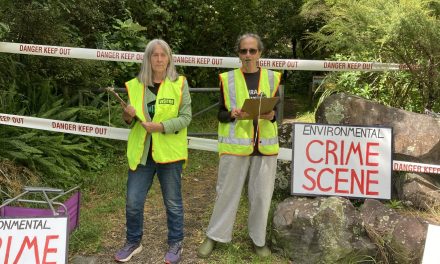
Kate (on right in black) joins a 2024 march in Pātea to oppose mining of the sea bed. (Photo supplied)
Kate Paris lives in Pātea and works as a teacher. She was raised on the West Coast in Greymouth and returned home to Taranaki when she was nine. She is a Greenpeace volunteer and sits on the Kiwis Against Seabed Mining committee. Her people arrived in Aotearoa from Scotland and England via Tasmania in the late 1800s.
Thank you for reading E-Tangata. If you like our focus on Māori and Pasifika stories, interviews, and commentary, we need your help. Our content takes skill, long hours and hard work. But we're a small team and not-for-profit, so we need the support of our readers to keep going.
If you support our kaupapa and want to see us continue, please consider making a one-off donation or contributing $5 or $10 a month.


Wonderful sentiment but every last thing in our material world is either mined or harvested.