

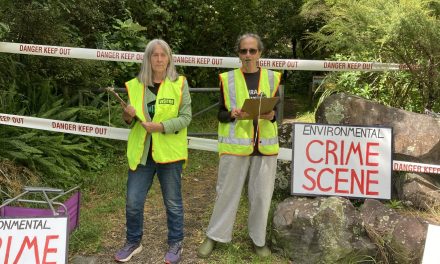
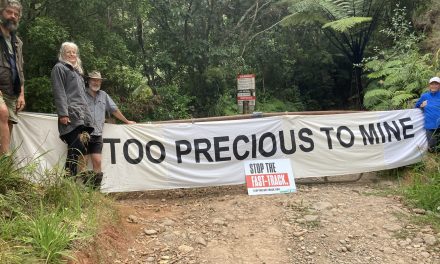
Anti-mining rally on Karangahake maunga, Kaimai Mamaku Conservation Park, in March 2024. (Photo supplied)
The government’s draft minerals strategy is open for public comment until Wednesday, July 31. Former Green MP Catherine Delahunty says the strategy is short-sighted and ignores the potential costs to the environment.
You could be forgiven for thinking that the government’s draft Minerals Strategy had been co-written by the mining lobby. I searched in vain for an acknowledgment that mining the land or seabed will have serious impacts on fossil fuel emissions, the biodiversity crisis, and the ocean. But there is none of that.
The strategy instead promotes the extraction of coal, gold, and rare earth minerals, in isolation from their impacts. It’s all about the great opportunities in the “clean energy transition” market and the jobs market. The strategy aims to double our mining exports to $2 billion by 2035, but it ignores the potential costs to the environment.
As we’ve seen in the Fast-tracks Approval Bill, tangata whenua can only be involved in mineral decisions in their rohe if minerals are already included in their deeds of settlement. But even then, that involvement is likely to be limited. In the Hauraki deed of settlement, for instance, minerals are mentioned, but the emphasis is on the Crown ownership of the one mineral being targeted here, gold.
If Act’s proposed Treaty principles bill ever becomes a reality (despite National’s promise not to support it beyond select committee stage) it has the potential to do further damage to the rights of tangata whenua to have a say on the use of resources in their rohe.
Mihingarangi Forbes’ Mata Report interview with Minister of Conservation Tama Potaka was disturbing. When asked if tangata whenua could say no to mining on their maunga, he would only say that coalition agreements had to be honoured.
The draft minerals strategy includes a right for tangata whenua to be “consulted”, but no right of veto. As my father James Delahunty used to say, when it comes to government promises to listen, consultation can rightly be defined as a cross between “a con and an insult”.

Hauraki kuia Betty Williams, of Ngāti Maru and Ngāti Pūkenga, believed in the life force of minerals, and argued that any proposal to mine the whenua had to first meet a “seven generations test”.
Behind the rhetoric about prosperity and clean energy, I hear the voice of a kuia from Hauraki who educated so many of us, including judges, about the vital tests for assessing the value of minerals.
Betty Williams (Ngāti Maru, Ngāti Pūkenga) believed in the life force of minerals, and argued that any proposal to mine the whenua had to first meet a “seven generations test”.
In the 1980s and ‘90s, those of us fighting the destruction of mining in our communities would sit in courtrooms designed for Pākehā law, listening to Betty’s kōrero. What she said reached way beyond the dollar and demanded a depth of understanding that no judge seemed to be capable of taking into consideration.
Undaunted, Betty told the courts that the gold already had a function within the earth, and gold’s sustainability must come first. This was an approach which the environmentalists, the lawyers, the multinational companies and the judges knew nothing about it. The mauri of gold was explained to us, but we barely grasped the meaning.
However, if you think about gold more deeply, it’s a metal that is found together with other far more toxic substances such as arsenic, lead, antimony and zinc. Left alone, they cause no harm within the earth, but when you mine the earth and crush the material to extract the gold, you change the form of some heavy metals which become dangerously toxic. Minerals such as gold have a function in the earth that we may not fully understand.
Betty was always trying to get the courts to understand that, for Indigenous people, good decision-making was about looking far beyond the short-term. She explained that the “seven generations wellbeing test“ meant that if the companies and the courts couldn’t prove that there would be at least seven generations of true benefit from extracting a mineral from its natural place, they should not be allowed to mine.
The kind of wellbeing and benefits envisaged in the test were not the short-term gains of a government receiving a 2 percent royalty for a few years, or a miner getting a job. It was wellbeing guaranteed by clean water and soil, good quality kai, and healthy relationships between all parts of the natural world, including ourselves.
Betty also regularly reminded us that the framework for considering these issues was Te Tiriti o Waitangi, not the Resource Management Act.
I was very lucky to be able to sit behind her and listen. Although Betty died in 2021, her voice remains in the heads and hearts of those of us who fought alongside her.
Her voice has never been more important as the government looks to push through the Fast-track Approvals Bill and a minerals strategy which, as currently drafted, allow no genuine participation for iwi, hapū and communities, in making decisions about whether we should be mining the land and sea.

Catherine (middle) with Renée Annan of Coromandel Watchdog and Betty Williams (right).
I was also recently inspired by a question I saw Tina Ngata ask on Facebook about the concept of “taonga species”. She was raising important issues as to why some species received that label in conservation spaces, but not others.
It reminded me of Betty Williams and her perspective that everything, from minerals in the earth to all other living things, had great value, in and of themselves. She never said that life was a hierarchy of aliveness, of value, or of sacredness, but that it was an interconnected life force expressing itself in many forms and functions.
Under the western, quasi-biblical beliefs that I grew up with, rocks were dead and trees only had limited life, animals were alive as lesser beings, and humans (in the form of white men, of course) were the pinnacle of evolution.
How much has this changed? Even our own science is now proving us wrong but our decisions about the world are still tainted by an ignorance of the interconnectedness of everything around us, to our peril.
I doubt the MBIE Minerals Strategy team will be interested in a submission about life force and the seven generations test.
The Minerals Strategy is strictly about hurrying up mining across the regions, helped by the Fast-track Approvals Bill, and claiming huge benefits to the country.
Applying the wisdom of Betty Williams, the only useful paragraphs in the strategy refer to the possibilities of reusing minerals that have already been mined. If we were to extract minerals such as gold, silver and palladium from our e-waste, we could reuse them for the greater good. The technology to do this is already available but the companies trying to make this a real option don’t have the support the Crown is giving to the traditional mining industry and are forced to look overseas for investment.
In a world where we have more than enough gold above ground and coal must be phased out to protect the climate, the rare earth mineral rush is a great public relations smokescreen, aimed at convincing us that mining the planet can save the planet.
The authors of the strategy paper seem excited by the proposed antimony mining at Reefton. Antimony is a rare heavy metal that’s associated with gold, and highly toxic. It’s used in military armour and bullets, as a flame retardant and in some electronics. Workers face high risks when mining it, and water quality can be badly affected. There is a cancer risk as well as risks to the heart, lungs and stomach.
This isn’t mentioned in the strategy, of course.
I find it more exciting that we can now source lithium from geothermal waste. The proposals to mine the seabed have failed in the courts due to a lack of robust science or tangata whenua support. But this fight is no longer about science, law or hapū and iwi knowledge. It’s about crude power attempting to override all avenues of opposition.
The one pro-mining argument that resonates on the streets is the possibility of jobs. But jobs in this industry are tied to the boom-and-bust cycle of the demand for minerals. In the long term, the industry plan is to replace human miners with robots.
Sure, there are jobs for some locals in the establishment phases of mining, but this doesn’t mean that we should support the industry. There are always jobs in crime, and the long-term environmental crimes of mining are incredibly costly to people and land and oceans. As concerns grow about the need to reduce human activities that harm our world, why aren’t we doing more to develop jobs in truly clean green industries?
In seven generations, in a climate-compromised world, we may not be talking about the extraction of minerals — we may be deep into mining landfills and electronic waste instead.
My profound hope is that we’ll be finally listening to the wisdom of peoples still connected to the living planet, and not lobbyists for multinational profits. Ngā mihi to Betty Williams and many other Indigenous voices, whose vision for their mokopuna is based on protecting te taiao, the natural world that all our children will inherit.
Catherine Delahunty is a Pākehā activist in environmental, social justice, and Te Tiriti o Waitangi issues. She is a writer and a tutor on social change issues, and a grandmother. Catherine was a Green MP for nine years and lives in Hauraki.
Thank you for reading E-Tangata. If you like our focus on Māori and Pasifika stories, interviews, and commentary, we need your help. Our content takes skill, long hours and hard work. But we're a small team and not-for-profit, so we need the support of our readers to keep going.
If you support our kaupapa and want to see us continue, please consider making a one-off donation or contributing $5 or $10 a month.




Catherine….Thank you for everything you write, all you have done and are doing and for keeping Betty’s words and aroha alive.
Ake ake ake
Mark